
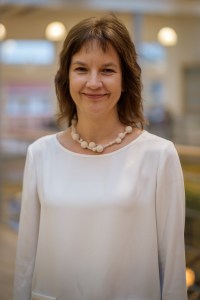
 Leelo Keevallik, Principle Investigator, Professor
Leelo Keevallik is a Professor in Language an Culture at Linköping University. She has a PhD in Finno-Ugric linguistics and has been working on the sociolinguistics, phonetics and interactional grammar of spoken Estonian. Her current research targets embodied interaction in various settings, such as dance and pilates classes, and collaborative physical work in multilingual companies. Her current work problematizes the boundaries of language, and she is now focusing on vocalizations at the edge of lexicon, and how the sensing body is incorporated into language in different ways. She is Principal Investigator of the Non-lexical vocalizations project, the Sounding for others project, and most recently a new grant on Syntax and the body (link in Swedish). In 2025, she was awarded the prestigious Swensons Prize for her contributions to linguistics (link in Swedish).
leelo.keevallik[@liu.se]
Emily Hofstetter, Associate Professor
Emily Hofstetter is an Associate Professor/Universitetslektor at Linköping University. They received their PhD from Loughborough University, examining how constituents and politicians discuss local concerns. Emily is a CARM Associate, and past work has examined several applied options for sociolinguistic research. Emily’s research aims to uncover how our bodies, sensations, and biological needs impact our social interactions . For these projects, she is primarily examining board gaming and rock climbing activities. For more information on conversation analysis, see Emily’s Youtube videos.
emily.hofstetter[@liu.se]
Former project collaborators:
Adrian Kerrison, Research Fellow
 Adrian Kerrison was part of the projects as a Postdoctoral Researcher/Postdoktor at Linköping University. He has a background in interpersonal communication and sport studies and received his PhD from Ulster University with a thesis examining how large crowds construct collective expressions of support during sporting events. His work on the project looks at how non-lexical vocalizations factor into mutual-monitoring, allowing us to ‘keep in touch’ across large-scale social settings. These are the momentary yelps, huffs, and grunts that provide individual assessments and collective moods, maintaining mutual understanding of the setting and its participants even when not in conversation together.
adrian.kerrison[@liu.se]
 Agnes Löfgren, Research Fellow
Agnes Löfgren contributed to the projects as a PhD researcher for the Non-lexical vocalizations project, and began postdoctoral research on interactional linguistics at Université de Neuchâtel in 2023 (link in French). She has also has master in Speech and Language Pathology, and is an adjunct lecturer at the Karolinska Institute. Her contribution to the project was an investigation into interaction in artistic contexts, focusing on the relationship between aesthetic and linguistic expression in opera rehearsals. She defended her PhD in 2023.
agnes.loefgren[@unine.ch]
 Hannah Pelikan, Assistant Professor
Hannah Pelikan contributed to the projects as a PhD researcher for the Non-lexical vocalizations project. She defended her PhD in 2023, and became a postdoctoral fellow for Wallenberg AI, Autonomous Systems and Software Program – Humanity and Society. She has since been awarded a position as the prestigious Pro Futura Scientia Fellow at the Swedish Collegium for Advanced Study, and will continue as assistant professor at Linköping University. Her research in the Non-lexical vocalizations project focused on non-lexical vocalizations uttered by robots, and how people interacted with the Cozmo robot, and has as her research program studying human interactions with robots.
hannah.pelikan[@liu.se]
 Sally Wiggins, Professor
Sally Wiggins is Professor in Psychology at Linköping University in Sweden. Her research interests focus on social interaction and discursive psychology, examining the ways in which embodied practices (such as eating, food preferences and gustatory pleasure and disgust) are enacted and become consequential in social contexts. For more on discursive psychology, see her textbook. For the projects, she has analysed non-lexical vocalisations in family mealtime interaction, such as use of the gustatory ‘mmm’, lip smacks and disgust markers.
sally.wiggins.young[@liu.se]

Kätlin Aare contributed to the projects as a PhD student in the Phonetics Lab at the University of Tartu, Estonia, and a visiting researcher in the Phonetics Lab at Stockholm University, Sweden. She holds a master’s degree in Linguistics from Stockholm University and is a board member of the International Speech Communication Association’s Student Advisory Board. Her PhD project focused on breathing during spontaneous conversations. Of particular interest are the functional use of resources for speech – air, namely – in the service of realising communicative intentions, and hidden events in conversational turn-taking, both investigated on the basis of physiological cues in the breathing signal.
katlin.aare[@ling.su.se|ut.ee]
 Non-lexical vocalizations